
The mission life of the 2,250kg GSAT-7A, built by ISRO, is eight years. It will provide communication capability to users in Ku-band over the Indian region.

Indian Space Research Organisation is all set for the launch of the first flight-testing of indigenous cryogenic engine on homespun rocket, Geosynchronous Satellite Launch Vehicle (GSLV-D3), from the Satish Dhawan Space Centre at Sriharikota at 4.27 pm on Thursday.

PSLV C-29 blasted off from the Satish Dhawan Space Centre, about 110 km from Chennai, at 6 pm and released the six satellites one by one into a 550 km circular orbit.
In a New Year gift to the nation, the Indian Space Research Organisation on Sunday successfully launched a Geosynchronous Satellite Launch Vehicle with an indigenous cryogenic engine from the spaceport of Satish Dhawan Space Centre in Sriharikota, entering a select club of nations.
India's ambitious attempt to flight-test its indigenous cryogenic engine on Thursday received a setback as the homegrown rocket Geosynchronous Satellite Launch Vehicle (GSLV-D3) deviated from path within seconds of lift-off.

The 3,423 kg GSAT-29 carries Ka and Ku band high throughput transponders intended to meet the communication requirements of users, including in the North East and in Jammu and Kashmir.

Indian Space Research Organisation will announce a revised launch date later.
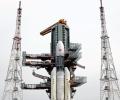
The Indian Space Research Organisation has released the first images of India's heaviest rocket, referred to as "Bahubali" days before it ferries India's Chandrayaan-2 into space. India's most ambitious space mission yet, Chandrayaan-2, which aims to place a robotic rover on the moon, will be launched on July 15 at 2:51 am. Here's all you need to know about the rocket.
India is planning two rocket launches next month that would carry on board homemade communication and remote sensing satellites, along with a Russian payload and a Singaporean micro spacecraft.

On Sunday morning, in its mission to place an earth observation satellite and students satellite into the low earth orbit, the SSLV-D1/EOS-02 blasted off precisely at 9.18 am amid cloudy skies from the first launch pad at Satish Dhawan Space Centre in this spaceport.
K Radhakrishnan, chairman of the Indian Space Research Organisation, has said that India is preparing to launch its second moon mission Chandrayaan-II by 2013. "The Chandrayaan-II we are planning to have in the year 2013. By that time, we should have our GSLV (Geosynchronous Satellite Launch Vehicle) flying with the Indigenous Cryogenic Engine Stage. That is the target with which we are working," said Radhakrishnan.
It is scheduled for lift-off at 1658 IST on Thursday from the space port at Satish Dhawan Space Centre at Sriharikota, about 100 km from Chennai.

The 3,357-kg satellite, which was deployed from the lower passenger position of Ariane-5 launch vehicle (VA 251) into the geostationary transfer orbit, is configured on ISRO's enhanced I-3K Bus structure to provide communication services from Geostationary orbit in C and Ku bands.
The launch is slated for 1658 IST from the space port at Sriharikota in Andhra Pradesh.

ISRO launched 12 Indian, 22 foreign satellites and successfully flight-tested India's first winged-body aerospace vehicle.
Indian Space Research Organisation is preparing to launch a geosynchronous satellite launch vehicle (GSLV-D3), powered for the first time by a home-made cryogenic engine, from Sriharikota spaceport this month, its chief K Radhakrishnan said on Friday.
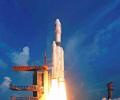
The rocket can put satellites weighing upto four tonnes in space, double the weight that the current GSLV-Mark-II can lift.

Indian Space Research Organisation's (ISRO's) heaviest rocket LVM3 will launch British start-up OneWeb's 36 broadband satellites from the spaceport in Andhra Pradesh's Sriharikota on October 23, marking the launcher's entry into the global commercial launch service market.

The 6-metre tall launch vehicle Vikram-S is named after Vikram Sarabhai, the father of the country's space programme and lifted off at 11.30 am.

The earth observation satellite would provide real-time images of the country and also be able to quickly monitor natural disasters.

The Indian space agency has already begun work on the third generation of the earth observation satellite -- the first of which will be ready by 2018 and boost the capability to generate digital maps.

A key feature of the satellite is providing mobile communication to India through multi beam coverage facility.

Noting that the PSLV was a versatile launch vehicle which can do different jobs and put satellites in different orbits, he said streamlining of this operation with improved capabilities is on.

GSLV Mark-III will be India's most powerful launch vehicle built to lift the heaviest Indian communications satellites to space.
The Department of Space (DoS) plans to realise entirely-built rockets -- GSLV-Mk III and SSLV -- from Indian industry partners, in addition to PSLV, according to a top official of its commercial arm NSIL.

Only three countries (United States, Russia and China) have successfully landed spacecraft on the airless lunar surface.
The Indian Space Research Organisation said that the countdown started at 6.51 am on Sunday.

The GSAT-31 is a 'high power' communication satellite going to serve and replace some of the satellites that are going to expire soon.

The ISRO had earlier said Chandrayaan-2 will be launched in a window from January-February 16, 2019.Sources said it is expected by the middle of next month but no date has been finalised.

Swapnila said they saw the GSLV Mk-III rocket that will launch the mission into space. "It was so huge," she added.
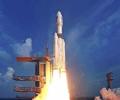
If successful, this would increase capacity to hurl small satellites into space, meeting both local demand and serving global customers.

'We are looking at a joint venture between ISRO and a few companies to assemble the PSLV and launch it from Sriharikota.' 'In a month or two, the vehicle assembly building will be ready.' 'After that, we could see 13, 14 launches a year.'
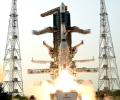
Over 32 missions -- satellites and rockets -- have been planned for the year.

The satellite would provide a thrust to mobile communication through multi-beam coverage facility, the ISRO said.

Bharti Group-backed OneWeb on Monday said it has entered an arrangement with the commercial arm of ISRO, NewSpace India Limited (NSIL), to launch its satellite in India from 2022.

The heaviest rocket of the Indian Space Research Organisation -- LVM3-M2/OneWeb India-1 -- blasted off from the Sriharikota spaceport on Sunday to place 36 broadband communication satellites into the Low Earth Orbit (LEO) for a UK-based customer.

Arianespace launch vehicle Ariane-5 VA-231, carrying GSAT-18 along with co-passenger Sky Muster II for the Australian operator nbn (National Broadband Network) was scheduled for launch at 2am on Wednesday.
Taking its baby steps towards realising India's ambition to send humans into space, Indian Space Research Organisation on Thursday successfully tested the atmospheric re-entry of a crew module after its heaviest launch vehicle GSLV MK III blasted off from Sriharkota.
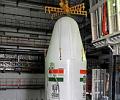
The launch of a Geosynchronous Satellite Launch Vehicle was called off by the Indian Space Reasearch Organisation at the eleventh hour on Monday due to a fuel leak in its second stage -- in a setback to the mission to test its homegrown cryogenic engine -- after its failure three years ago.
 © 2026 Rediff.com - Advertise with us - Disclaimer - Privacy Policy - Sitemap - Feedback - About us - Terms of use - Grievances